
Natural History
How to Judge a Mineral Specimen
A mineral specimen is worth what its locality, its condition and its honesty make it worth. The useful questions are where it came from, what has been done to it, and how sure anyone can be about what it is.

Two specimens of the same mineral can look equally good on the day they are bought and be worth very different amounts a few years later.
The difference is rarely in the crystals. It is in what is known about them: where they were found, what has been done to them since, and how confident anyone can be about what they are.
Those are the three questions worth asking of any mineral specimen, in that order.
Locality is part of the specimen
A mineral species can always be identified again. A locality, once lost, usually cannot.
Mindat, the reference database most collectors and curators use, records localities as a hierarchy running from the most specific place, usually a mine or quarry, out to the country. A specimen labelled with a named mine is a different object from one labelled only with a country, even if the two look identical.
Locality matters scientifically because it ties the specimen to a geological setting. It matters to collectors because the best specimens from a locality become the standard against which others from the same place are judged. The Mineralogical Record’s guidance to its locality authors makes the same point.
Old labels are part of this record. A dealer’s or collector’s label written decades ago can be the only surviving evidence of where a specimen came from. Labels are easily separated from the specimens they describe, so a label that has stayed with its specimen is worth keeping, photographing and recording.
When we catalogue a specimen, we give the locality at the level of detail we can support, and say so when it goes no further than a region.
Artigas, as an example
The Artigas region of northern Uruguay shows why locality carries so much weight.
Its amethyst and agate geodes formed in basalt lava flows of the Paraná–Etendeka volcanic province, erupted during the Early Cretaceous as Gondwana broke apart. Researchers at the University of Göttingen date the lavas to roughly 134 million years ago. The Los Catalanes district, south of the town of Artigas, has been worked for amethyst for more than 150 years, and in 2022 it was named one of the International Union of Geological Sciences’ Geological Heritage Sites.
Calcite is a common companion in these geodes. Some Artigas specimens show amethyst that grew over calcite crystals which later dissolved away, leaving the quartz in the shape of the calcite. That history is visible in the specimen, but only someone who knows the locality will read it correctly.
“From Artigas” therefore tells a buyer a great deal. “From Uruguay” tells them much less. “Brazil or Uruguay” tells them almost nothing.
Condition, as we assess it
There is no formal grading scale for mineral specimens. What follows is how we look at one, and it should be read as the judgement of a dealer, not a published standard.
We look first at the crystals: how sharp their faces and edges are, how good the lustre is, and whether the colour is typical for the species and the locality. Then we look for damage. Chips and bruises on crystal edges and terminations are the most common faults, and they matter more on a small, sharp crystal than on a massive one.
We also look at the piece as a whole. A specimen on its natural matrix usually says more about how it formed than a loose crystal does. Size is judged against what the species normally produces, not against other minerals.
None of this replaces looking at the specimen yourself, or at photographs good enough to show the faults as well as the strengths.
What has been done to it
Mineral specimens are often treated, and treatment is not always visible.
The Gemological Institute of America is clear that treatments should be disclosed, and that some are difficult to detect even for specialists. The ones a collector is most likely to meet are these:
- Heating. Most citrine on the market is heated amethyst, because natural citrine is comparatively rare. Heat can also lighten amethyst that is too dark.
- Dyeing. Porous material, agate above all, takes dye readily. A colour that does not occur in nature is a reliable sign of it.
- Coating. Quartz sold under names such as “Aqua Aura” has been coated with an extremely thin metallic film, deposited in a vacuum. The colour is applied, not grown.
- Repair and restoration. A repaired specimen has had a clean break rejoined. A restored one has had missing material replaced. Both are legitimate if they are disclosed, and neither should be presented as an undamaged natural specimen.
- Cleaning. Dilute acid dissolves calcite and leaves quartz untouched, so calcite can be removed from a quartz or amethyst specimen leaving little sign it was ever there. A specimen can be changed by cleaning without anything being added to it.
Our entries state any treatment, repair or cleaning we know of. Where we do not know, they say that we do not know.
How sure is the identification?
Many minerals can be identified by eye by someone experienced. Some cannot, and fine-grained or coated material is where visual identification is weakest.
A mineral species is defined by both its chemistry and its crystal structure, and the International Mineralogical Association decides which species are recognised. Chemistry alone is not always enough to settle an identification. Laboratories confirm the species with methods such as X-ray diffraction and Raman spectroscopy, often in combination.
Simple tests can separate some common confusions. Calcite is calcium carbonate, with a hardness of 3, and it fizzes in dilute acid. Chalcedony is microcrystalline quartz, with a hardness of about 6½ to 7, and it does not. Both tests mark or damage the surface, though, and neither is something to do to a fine specimen.
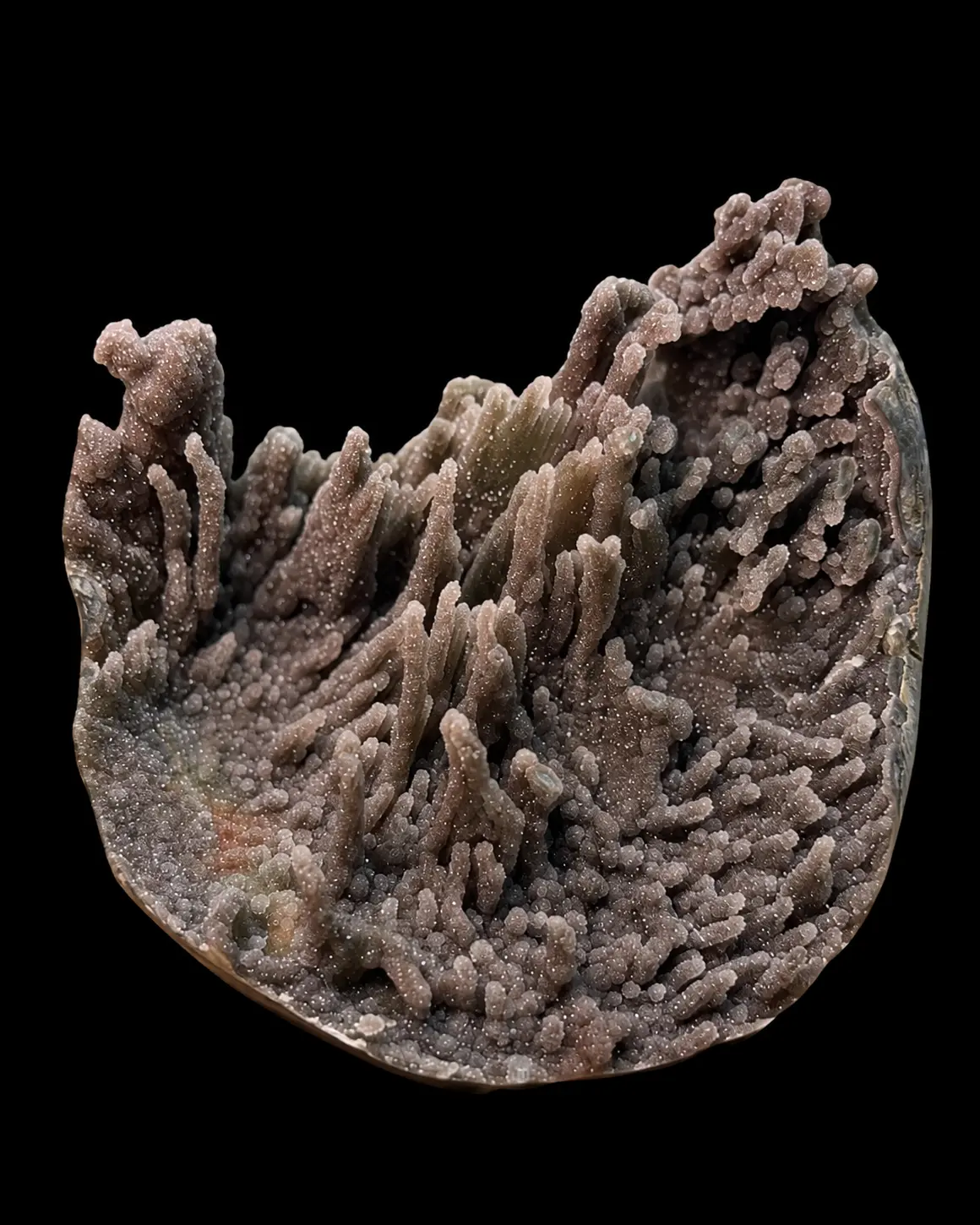
That is why some of our entries describe a specimen’s mineralogy as unconfirmed. Our sculptural mineral formation from Artigas is one: it has been tentatively described as calcite or chalcedony, and the entry says plainly that this has not been verified by analysis. The price reflects the specimen as described, not as it might turn out to be.
What to ask before buying
Ask where the specimen was found, as precisely as the seller can say, and how they know. Ask whether there is an old label, and whether it has stayed with the specimen. Ask what has been done to it: heating, dyeing, coating, repair, restoration or acid cleaning. Ask whether the identification rests on analysis or on observation.
A good seller will answer each question directly, including with “we do not know”. For how we approach these questions across every department, see our provenance and authenticity standards. For the specimens we currently hold, see Natural History.
Sources consulted
- Mindat, Locality hierarchies and naming conventions
- Mindat, How to document mineral specimens
- Mineralogical Record, Guide to writing locality articles
- Mineralium Deposita (2024), World-class amethyst-agate geodes from Los Catalanes, northern Uruguay
- University of Göttingen, Amethyst geodes of Uruguay
- Geoconservation Research (2023), Los Catalanes Gemological District
- GIA, An introduction to gem treatments
- GIA, Is citrine treated?
- Mindat, Aqua Aura
- GIA, Gems & Gemology (Winter 2024), Raman spectroscopy and XRD
- Mindat, Calcite
- Mindat, Chalcedony
Related collection
Natural History